Rhythmic marks
Lines and dots punctuate the flow.
A new rhythm between marks.
From the artist’s fluorescent handwriting, new forms come into view.
Tap a mark to look closer
Explore the relationship between marks. Each adjustment rearranges the existing glyphs.
Built on the artist’s fluorescent handwriting, Generator explores how the structure of a mark can develop into a new form.
A mark begins with the centre lines of its strokes. These skeletons establish the structure of compact signs and extended, creature-like forms.
The rendering stage follows the skeleton, giving the strokes their width, texture and fluorescent colour.
Lines are refined and stray fragments removed, retaining the dots, eyes and small features that give each form its character.
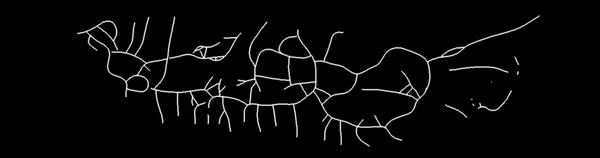
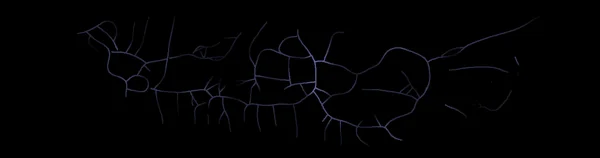
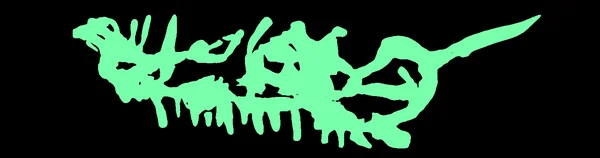
White, blue and green distinguish stages in this process study; they are not the model’s output colours. Model-generated examples, separate from the interactive glyph pool.
Hand-painted marks and generated glyphs are documented separately. Their relationship lies in the evolving practice, rather than a one-to-one pairing.
These marks do not form a language with fixed translations. Their grammar emerges through repetition, intervals, scale and the relationships between forms.
Lines and dots punctuate the flow.
Compact gestures create intervals and shifts.
Extended structures carry movement across a line.
Rhythmic marks, compact signs and extended forms alternate across the wall. Changes in scale and spacing alter the rhythm of a passage. Open “Shape the rhythm” above to explore your own arrangement.
A conditional diffusion system trained on the artist’s own handwriting. Two canvas formats share a skeleton network; a separate rendering model develops the painted strokes. The work continues through generation, selection and arrangement.
The training dataset contains 8,267 glyphs extracted from the artist’s own fluorescent hand-painted work. The skeleton model is a U-Net with approximately 72 million parameters. The archive’s 10,667 records have a different scope: records may include related appearances and source versions. They should not be read as 10,667 distinct characters used in training. Generated glyphs remain separate and are not added back to the training set.
Compact marks and elongated forms are trained on two canvas formats with different aspect ratios. Both share the same network weights. Convolution and attention operate without positional encoding, allowing the network to work across these formats while learning the relationships between strokes.
Kind, length, density and source are embedded separately, then combined to guide generation. This makes it possible to explore combinations that occur less often in the original walls. Some conditions are withheld during training so the system can also work with partial guidance. These conditions describe visual structure rather than linguistic meaning.
The skeleton model learns the distribution of stroke centre lines through conditional diffusion. New structures emerge through iterative denoising. The training method uses a cosine noise schedule and v-prediction, with an exponential moving average of model weights. Gentle geometric augmentation and extra emphasis on strokes and nearby pixels help keep fine lines relevant to learning.
A separate rendering model receives the skeleton and a stroke-width representation. It develops the surface of the mark, including width, texture and colour. Added conditioning weights are initialised at zero so the model can gradually learn to follow the supplied structure. The process diagrams use explanatory colours; the website’s blue-and-pink vector display is a presentation layer, not a reproduction of every rendered colour variation.
Finishing refines contours and removes stray fragments while preserving dots, enclosed spaces and small features such as eyes. Selection considers structural completeness, the character of a stroke and variation across a group. Rendering on new skeletons is compared with rendering on training skeletons to investigate memorisation and generalisation. These checks inform review; they do not certify originality or replace artistic judgement.
Generating a glyph and composing a wall are separate operations. Arrangement draws on the rhythm of the existing writing: changes of form, intervals, relative scale and line spacing. A successful single glyph may still need a different place or neighbour to work within a passage. The controls above let visitors explore this stage of composition.
Training and glyph generation take place separately on GPU hardware. The website loads pre-generated vector glyphs; rearrangement, scale changes and spacing adjustments happen in the browser. Clicking a glyph or changing a layout does not run the model or create a new glyph. New experimental batches are reviewed before publication.